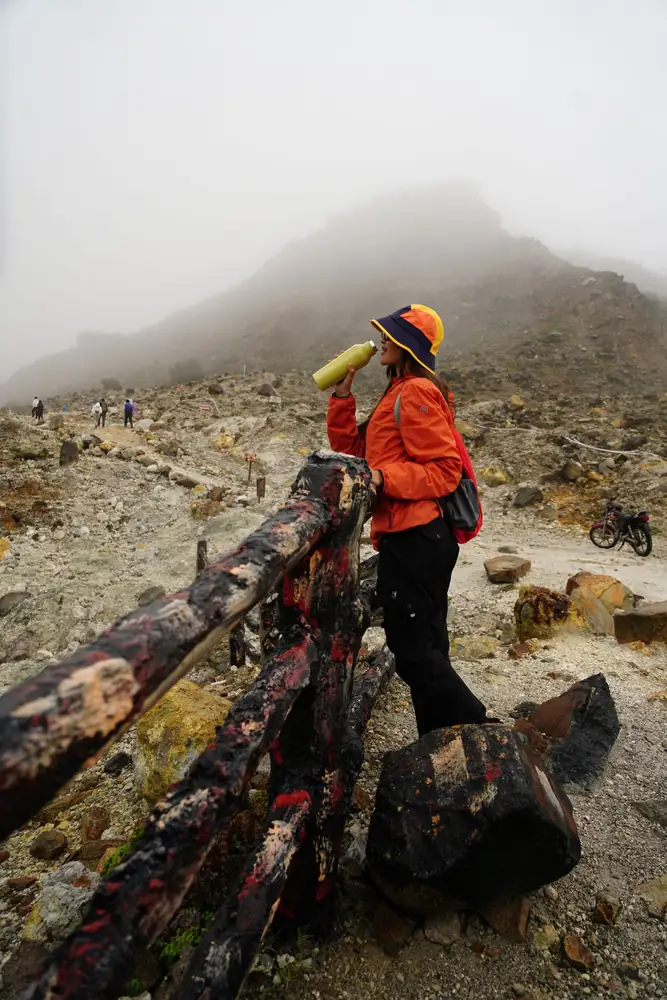
Bottom line: there is no safe universal bottle count. Plan from time, heat, exposure, effort, elevation, body size, and reliable refill points. For ordinary mild-weather day hiking, many people use roughly half a liter per hour as a planning start; hot desert guidance can reach about one liter per hour. Local park advice should override a generic rule, and every plan needs a reserve.
This is general outdoor education, not medical advice. Heat illness and dehydration can become emergencies. Check the managing agency’s current trail conditions, water status, and warnings before departure.
Why mileage alone is a poor water calculator
Eight shaded miles beside reliable treated water are different from four exposed miles in dry heat. Climbing, pack weight, altitude, humidity, pace, and acclimatization change demand. So do delays: navigation errors, an injured companion, a closed source, or a filter that clogs.
Estimate time outside, not just moving time. Add breaks, photography, side trips, and the slowest person in the group. Then apply the most relevant local guidance and add a reserve appropriate to the route’s consequences.
A route-based planning worksheet
- Estimate total hours from trailhead back to trailhead.
- Classify temperature, sun exposure, effort, altitude, and humidity.
- Mark only water sources confirmed by a recent, authoritative report.
- Decide whether each source needs filtering, chemical treatment, boiling, or avoidance.
- Calculate capacity to the next dependable source plus a delay reserve.
- Set turnaround points tied to time and remaining water.
Example planning ranges
| Scenario | Planning approach | Main risk |
|---|---|---|
| Cool, shaded local walk | Start near 0.5 L per hour, then adjust | Underpacking because the trip feels familiar |
| Warm exposed day hike | Increase capacity and carry electrolytes/food appropriate to the day | Heat and direct sun |
| Hot desert route | Follow park-specific guidance; some NPS pages advise about 1 L per hour | Rapid loss, no shade, unreliable sources |
| Route with refills | Carry to the next confirmed source plus reserve and treatment | Dry, frozen, contaminated, or crowded source |
These are planning examples, not prescriptions. Health conditions and medications can change needs. Drinking excessive plain water can also be dangerous, which is another reason to avoid turning a rough rate into a competition.
What counts as a reliable source
A blue line on a map is not proof of flowing water. Seasonal streams dry up; pumps break; cattle ponds become unusable; freezing weather stops filters and taps. Prefer same-week ranger updates, official trail alerts, recent field reports, and direct observation from someone who traveled the route.
Carry treatment appropriate to likely contaminants and know its limitations. A filter can fail mechanically or freeze after use. Chemical treatment needs contact time and may not remove every contaminant. On consequential routes, carry a backup method.
Bottles, reservoir, or both?
Soft reservoirs make frequent sipping easy and carry weight close to the back, but remaining volume is hard to see. Bottles show inventory, are easier to share, and isolate a leak, yet may be awkward to reach. A mixed system gives convenient drinking plus a visible reserve.
Whatever you choose, practice accessing it while wearing the pack. A full bottle that stays buried because removing the pack is annoying does not support steady hydration.
Build a real reserve
A reserve is not the last normal sip scheduled for the parking lot. It is water kept for delay, wrong turns, unexpected heat, or another hiker. The amount depends on how long rescue or retreat would take. Remote, exposed routes deserve more margin than a busy park loop beside roads.
Set a turnaround rule before starting, such as leaving the destination when a fixed time arrives or when remaining water reaches the amount needed for the return plus reserve. The summit is optional; the trip home is not.
Reduce demand before adding weight
- Start early to avoid the hottest hours.
- Choose shade and reduce pace when heat rises.
- Wear sun-protective clothing and a hat.
- Drink before the hike and eat normally.
- Keep water accessible and take regular checks.
- Shorten or cancel the route when advisories, heat, or source uncertainty exceed the plan.
Warning signs and response
Thirst, headache, unusual fatigue, dizziness, nausea, confusion, poor coordination, or a change in sweating can signal trouble. Stop, seek shade, cool the person, and use the emergency plan. Confusion, collapse, or severe symptoms require urgent help; do not try to “push through” to save the itinerary.
Travel with someone who knows the plan, leave route details with a trusted contact, and carry a communication method suited to coverage. Water planning is one part of the Ten Essentials, not a substitute for navigation, insulation, light, first aid, food, fire, repair tools, and emergency shelter.
Common mistakes
- Using one liter-per-mile rule regardless of speed or weather.
- Counting an unverified creek as guaranteed.
- Starting dehydrated after a long drive.
- Carrying all water in one container that can leak.
- Drinking too little to make the load last.
- Ignoring local closures and heat advisories.
Test the plan on a lower-consequence day
Before committing to a remote route, rehearse on a familiar trail with an easy exit. Weigh or mark the containers at the start and finish, record weather and moving time, and note whether you shared water or ended thirsty. One outing is not a formula, but several records reveal how conditions change your actual use.
Keep the result conservative. Finishing with a reserve means the plan worked; it does not prove the reserve was unnecessary. Increase the margin when the next route is hotter, higher, longer, more exposed, or farther from help.
FAQ
Is half a liter per hour always enough? No. It is only a common mild-condition starting estimate. Heat, direct sun, effort, altitude, body size, and local guidance can raise or lower the need.
Can clear mountain water be drunk untreated? Clarity does not prove safety. Follow the managing agency’s advice and use appropriate treatment.
Should I carry sports drink? For long, hot, sweaty efforts, food and electrolyte replacement may be useful. Avoid treating concentrated products as a substitute for adequate water.
What if the water is heavy? Shorten the route, start cooler, or plan verified refills with treatment. Weight is not a reason to leave without the needed capacity.
Sources
- National Park Service, Hike Smart.
- National Park Service, Hawaiʻi Volcanoes hiking tips.
- National Park Service, Saguaro hiking safety.
Once you know how much water the route requires, the next decision is how to treat what you refill: see our guide to water filters vs purification tablets.